Rally car insurance: all what to know
In this guide we are going to explain how Rally car insurance works according to what is used in most of European countries.
When using rally cars (and race cars in general) owned by teams or tuners, they provide cars that are mechanically and aesthetically like new. For this reason, in the event of damage, it is the customer’s responsibility to repay such damage to return the car to the same conditions. To support in this operation and reduce the possible economic outlay, there are specific insurance brokers specialized in motorsport who offer insurance policies in this regard.
When participating in a race and you rent a rally car, as well as in all of the Gravel Rally courses of the Vittorio Caneva Rally School, each driver has the option of purchasing an insurance coverage to lower the outlay to be paid in the event of an accident.
How rally car insurance works
It is made up of two components which we will go into further detail:
- insurance fee
- deductible
The insurance fee: it is the cost that must be paid to activate the insurance coverage. It varies from car to car, from the type of event, from the number of days of coverage, from the driver’s statistical history. Once the insurance coverage has been purchased and used, this amount is not refunded.
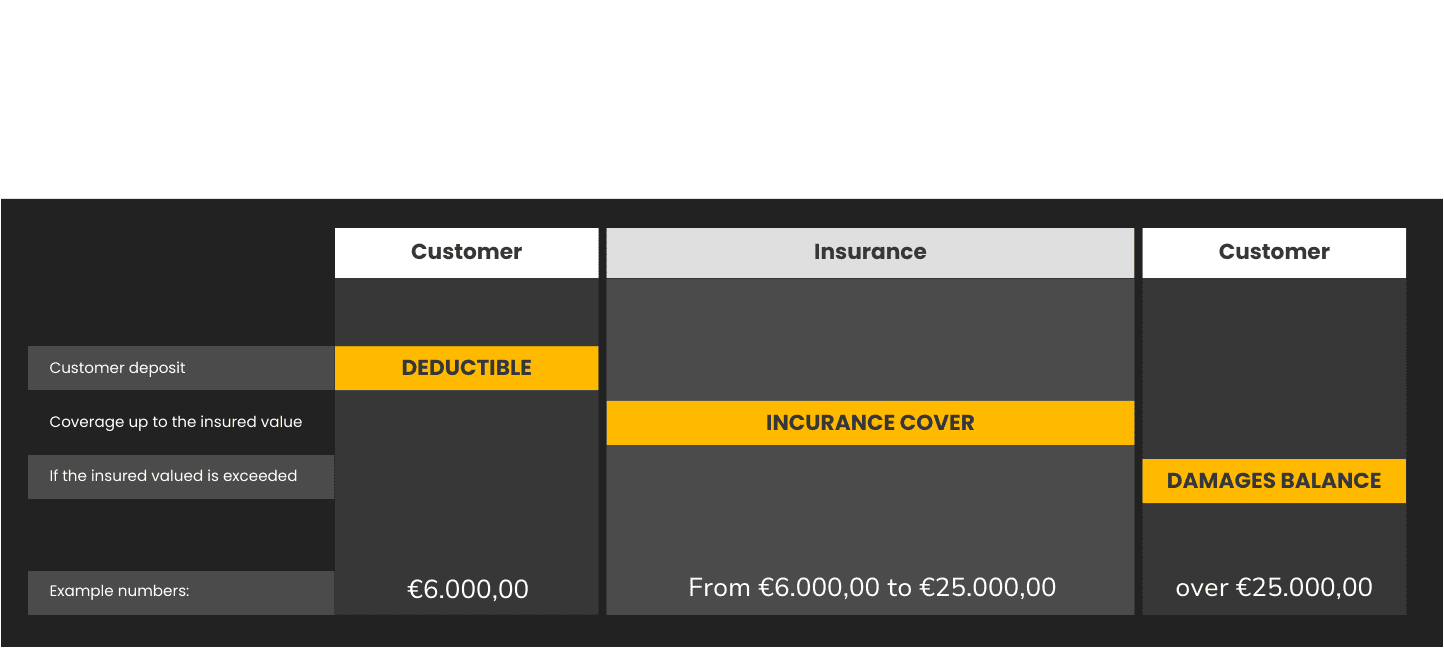
The deductible: every insurance coverage request a deductible. This is an amount to be paid as a deposit in the event of damage. The insurance policy covers damages starting from the value of the deductible up to the insured value. Below the value of the deductible the damages are paid by the customer, above (and up to the insured value) the insurance covers.
There are then clauses, depending on the insurance itself, which exclude certain damage to the vehicle such as damage to the engine due to over-revving, as well as to the gearbox. Generally the policies cover damage due to impact, accident, off-road.
Practical examples of how Rally insurance works
Car: Peugeot 208 Rally 4
Insurance cost: €780.00/day
Deductible: €6,000.00
Insured value: €25,000.00
- Example A: damage worth €4,000.00
This damage is less than the value of the deductible, €4,000.00 from the deductible is withheld to pay for the damage. At the end of the event €2,000.00 is returned to the driver.
- Example B: damage worth €15,000.00
This damage is greater than the value of the deductible, the total amount of it is withheld (€6,000.00). The insurance covers the remaining amount of €9,000.00 (total saved: €8.220,00 instead of paying €15.000,00 for the demages).
- Example C: damage worth €30,000.00
Since this value is higher than the value of the deductible (€6,000.00), the deductible is entirely retained. the insurance covers the damage from €6,000.00 up to €25,000.00), from €25,000.00 up to €30,000.00 of the damage covers the customer again. In total the customer will have paid €6,000.00 of the deductible + €5,000.00 of the difference between the damage and the insured value (€11,000.00 paid for a damage of €30,000.00, total saved: €18.220,00). It is possible to request an increase in the insured value. This will result in an increase in the cost of the insurance policy.
Conclusions
By competing with rally cars own by third people, each driver has the opportunity to protect himself by reducing the cost to be covered in the event of damages. For many activities, insurance is only an option and not mandatory. Each driver also has the possibility of obtaining personal insurance by contacting a broker specializing in Motorsport directly.