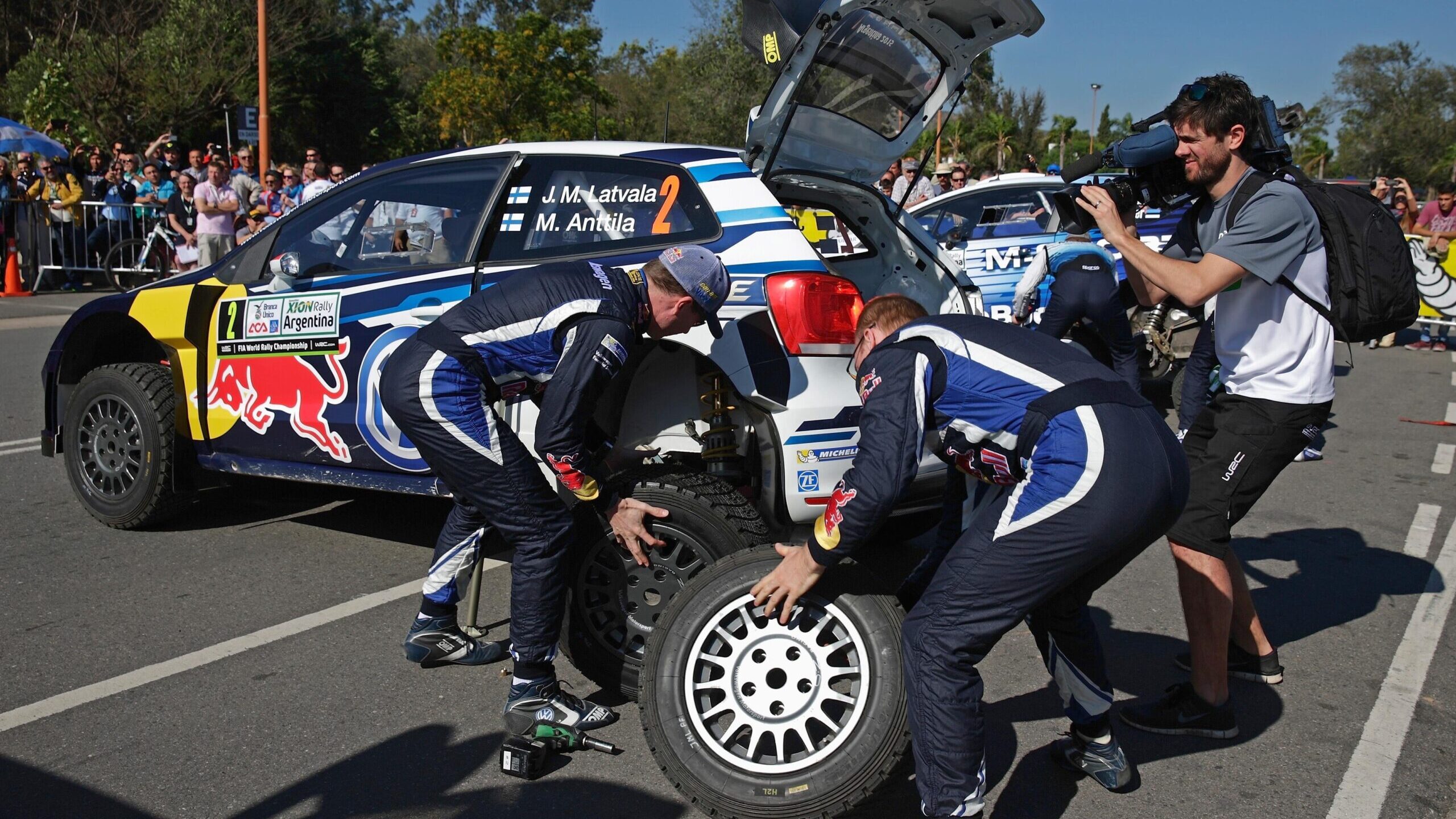
Tire change: master the art of saving time, staying safe, and keeping control even under the pressure of a puncture on stage.
Changing a wheel in a rally car is not just a pit stop, it’s a discipline of precision, speed, and teamwork. Whether it happens mid-stage on gravel or during a transfer section, how the crew reacts can define the result of an entire rally. At Vittorio Caneva Rally School, we train drivers and co-drivers to execute the operation with professional efficiency. Here’s how the world’s best rally crews do it.
The Ideal Procedure: Roles and Coordination
A rally wheel change is not a random reaction, it’s a choreographed move between driver and co-driver. Each second saved comes from clear role division and smooth coordination.
Objective: Efficiency, safety, and consistency under pressure.
Target time: 1’10”–1’30”
In this example, the driver operates both the jack and the impact gun, while the co-driver manages the wheels and equipment. The real procedure depends on the specific car and where on the car tools are positioned. A version of the process unfolds as follows:
| Phase | Driver | Co-driver |
|---|---|---|
| 1. Stop and safety | Stops the car in a safe, flat area; applies handbrake; engine idling | Stays in seat until the car is fully stopped and stable |
| 2. Preparation and jack positioning | Gets out, opens the trunk, takes the impact gun | Unfastens seatbelts, exits, moves to the back of the car taking the jack and lifting the car |
| 3. Loosening wheel nuts and bringing spare tire | Uses the impact gun to loosen wheel nuts, removes the punctured tire | Comes back to the trunk to take out the spare wheel. Brings the spare wheel to the change side |
| 4. Tyre change | Fits the new wheel on the hub, tightens with the impact gun (cross pattern) | Takes the punctured wheel, puts it back in the trunk, and secures it with straps or ratchets |
| 5. Equipment storage | Puts jack and impact gun back in the trunk, returns to the car | Checks that all tools and wheels are secured, then closes the trunk |
| 6. Re-entry and restart | Sits down, fastens belts, confirms via intercom, restarts smoothly | Same procedure and get ready to restart reading the pace notes |
Safety and Technical Notes
- All equipment and wheels must be secured with FIA-approved straps or ratchets (ref. Art. 252-2.2).
- The jack must always be placed on the manufacturer’s lifting points.
- Operate from the inner side of the road whenever possible.
- Do not start if both driver and codriver are safely positioned in the car, with seat belts fastened
- After the change, drive the first kilometer progressively to stabilize handling.
- Perform a visual check of the nuts once on the road section.
Stage vs. Road Section: Knowing When to Push or Take Time
Not every wheel change happens in the same conditions. The difference between a special stage and a road section can completely change the approach.
On a Special Stage (SS):
Everything is about speed and minimizing time loss. The driver uses only the impact gun, without a torque wrench. Bolts are tightened quickly in a cross pattern, ensuring the wheel is safely mounted. The crew must always stop in a visible, secure location — never in blind corners or narrow sections. If the puncture occurs within three kilometers of the finish, it’s often faster to continue to the end.
On a Road Section or Service Area:
Here, there’s time for precision. After the impact gun, the crew can verify the torque manually or with a torque wrench (110–120 Nm for Rally2/Rally4). Tire pressure and wheel bolt integrity should always be checked before rejoining competition.
The Strategic Choice: Change or Continue?
A puncture doesn’t always mean you should stop. Deciding whether to change the wheel or keep driving depends on distance, damage, and drivetrain.
- If the puncture is minor and there are less than 3 km left in the stage, continuing is usually faster. Expect a time loss of 6–8 seconds per kilometer.
- If the tire is completely flat or the rim risks damage, stopping is the better option. A well-coordinated crew can complete the change in 1’10”–1’30”
- For front-wheel-drive cars, a front puncture drastically affects handling, changing the wheel becomes most of the times mandatory.
At this level, decision-making is as important as the mechanical action itself.
Why We Teach It This Way
At Vittorio Caneva Rally School, every exercise is built from decades of experience in WRC and international rallying. The wheel change drill is more than a service task — it’s a controlled high-pressure scenario that develops teamwork, situational awareness, and decision-making.
Because in rallying, a puncture doesn’t just test the tires — it tests the crew.