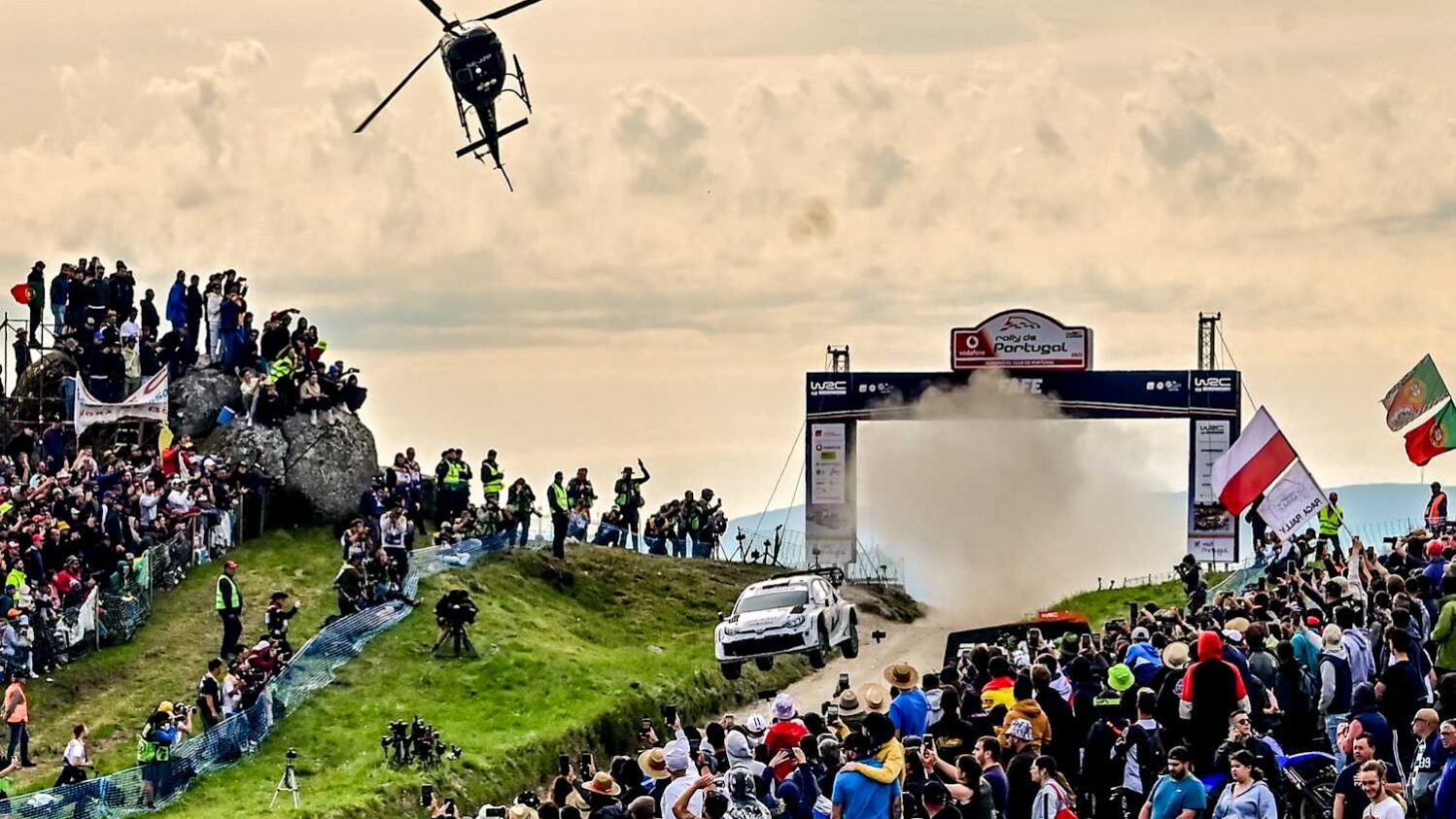
WRC Rally Portugal starts today. Here is everything you need to follow the sixth round of the 2026 FIA World Rally Championship
WRC Rally Portugal 2026: full schedule, key stages, entry list highlights and the main talking points heading into the first classic European gravel event of the season.
Vodafone Rally de Portugal is underway today, Thursday 7 May, and runs until Sunday 10 May. The 2026 edition is based at the Exponor service park in Matosinhos, near Porto, with a ceremonial start in Coimbra and a route that brings the championship onto fast, technical and abrasive gravel roads.
This is one of the rallies where road position, tyre behaviour and surface evolution can change the whole shape of the weekend. The opening cars clean the loose gravel, while those behind can find more grip but also deeper ruts, exposed stones and more punishment for the tyres.
The 2026 route features 23 special stages and 344.91 competitive kilometres, with a total route of 1,874.58 km. Amarante is the longest stage of the rally at 26.24 km, while the final pass of Fafe hosts the Wolf Power Stage.
Event Overview
| Event Name | Vodafone Rally de Portugal 2026 |
| Championship: | World Rally Championship 2026 – Round 6 |
| Location | Matosinhos, Porto, Portugal |
| Dates | 7–10 May 2026 |
| Surface | Gravel |
| Stages | 23 special stages (344.91 km competitive distance) |
| Total length | 1,874.58 km (including road sections) |
| Official Website: | Visit the event page |
WRC Social Media, Live Streaming & Highlights
| Instagram: @fiawrc | Live Streaming: Rally.Tv | YouTube: FIA WRC Channel | Facebook: FIA WRC Page |
WRC Portugal 2026 Schedule & Itinerary
Wednesday 6 May: Shakedown in Baltar
The rally week begins with the Baltar shakedown, a 5.72 km test that gives crews their first proper read on gravel balance, traction and tyre response. It is not about chasing a headline time. It is about confirming that the car has the right platform for a rally where the grip level will keep moving from one loop to the next.
Portugal rewards a car that rotates cleanly but still protects the tyre. Too much slide and the crew will pay later in the loop. Too little rotation and the car starts pushing wide on the loose surface. That balance starts here.
Thursday 7 May: Coimbra start and first competitive kilometres
The competitive route opens with Águeda / Sever, followed by Sever / Albergaria and the short super special in Figueira da Foz. Thursday is compact, but it already gives the rally a clear technical direction: find grip early, keep the car clean and do not let the first loop create unnecessary damage.
The first cars on the road will have to deal with loose gravel and surface cleaning. That makes line choice critical. The fastest approach is not always the most spectacular one. On Portuguese gravel, the best drivers make the car work with the road instead of fighting it.
Friday 8 May: Mortágua, Arganil, Lousã and Góis bring the first major gravel test
Friday takes the rally into the Central region with Mortágua, Arganil, Lousã and Góis. This is where the rally starts to build real pressure. The stages are technical, rhythm changes arrive quickly and the crews need to stay accurate when the road alternates between faster gravel, narrower sections and more aggressive surface changes.
Arganil and Lousã are proper reference stages. They demand confidence in braking, precision on entry and strong traction discipline on exit. Góis adds another layer, because the driver has to stay committed while still keeping the car inside a safe operating window.
This is the day when road evolution can open gaps. Crews who understand how the grip is building will be able to carry speed more efficiently. Crews who overdrive will start taking life out of the tyres before the loop is complete.
Saturday 9 May: Felgueiras, Cabeceiras de Basto, Amarante and Paredes
Saturday is the longest and most demanding day of the rally, with two passes through Felgueiras, Cabeceiras de Basto, Amarante and Paredes, before the Lousada super special closes the day. This is the main endurance test of the event.
Amarante, at 26.24 km, is the longest stage of the rally and one of the key places where the result can move. It asks for sustained concentration, tyre control and a car that can keep its balance over changing grip. Any small mistake in rhythm costs time for kilometres.
This is also where set up and driving style become tightly connected. If the car is too nervous, the driver spends too much energy correcting it. If the car is too safe, it will not rotate enough. The quickest crews are those who can keep momentum without disturbing the platform.
Sunday 10 May: Vieira do Minho, Fafe and the Power Stage finish
Sunday closes the rally with two passes through Vieira do Minho and Fafe. The final pass of Fafe is the Wolf Power Stage, which means the rally finishes with extra championship points on one of the most iconic stages in the WRC.
Fafe is not just a stage for the cameras. The jumps, crests and compression zones demand exact car placement. The driver has to commit, but the landing zone and the next braking point are just as important as the jump itself.
Portugal can still change on Sunday morning. Tyre wear, road cleaning and road position remain important until the final control. Like every proper gravel rally, this one is only over when the car is back with all four corners intact.
Entry list highlights
Rally Portugal 2026 has a strong Rally1 field across the factory teams. Toyota brings Sébastien Ogier, Elfyn Evans, Takamoto Katsuta, Sami Pajari and Oliver Solberg. Hyundai fields Thierry Neuville, Adrien Fourmaux and Dani Sordo. M Sport Ford arrives with Mārtiņš Sesks, Josh McErlean and Jon Armstrong.
The WRC2 field adds major depth, with names such as Roope Korhonen, Yohan Rossel, Nikolay Gryazin, Gus Greensmith, Teemu Suninen, Jan Solans, Giovanni Trentin, Mille Johansson, Armindo Araújo and Alejandro Cachón among the drivers to watch.
That makes Portugal more than a Rally1 fight. It is a full gravel benchmark across the categories, especially in Rally2 where tyre management, road position and stage reading can make the difference between a podium run and a weekend spent recovering time.
One technical factor to watch this weekend
Road cleaning could be one of the decisive factors. Portugal is a classic loose gravel rally, especially on the first pass. The first cars sweep the surface, while the following crews often find a cleaner line with more grip. But the advantage is not automatic, because second pass conditions can bring exposed stones, deeper ruts and more risk for tyres and suspension.
That means the rally will reward drivers who can adapt their technique without changing their mental rhythm. Early in the loop, the car needs patience and clean traction. Later, when the road is more defined, it needs commitment and accuracy. The best crews will manage that transition better than the rest.
Why Portugal changes the normal gravel logic
Portugal is fast, but it is not simple. The road can look flowing and open, yet the grip underneath the tyre changes constantly. Some sections invite the driver to attack, while others demand protection. That is what makes this rally a true European gravel reference.
From a driving point of view, Portugal is all about braking stability, controlled rotation and efficient traction. The car has to slide enough to point toward the exit, but not so much that it overheats the tyre or loses forward drive. This is the same principle we work on in our gravel training: the slide must produce speed, not just angle.
Crews who stay smooth, precise and disciplined usually rise through the field here. The stopwatch rewards the driver who understands when to attack and when to let the car breathe.
Full stage schedule
Wednesday 6 May
Shakedown Baltar, 5.72 km
Thursday 7 May
SS1 Águeda / Sever, 15.08 km
SS2 Sever / Albergaria, 20.24 km
SSS3 Figueira da Foz, 1.93 km
Friday 8 May
SS4 Mortágua 1, 14.59 km
SS5 Arganil 1, 18.62 km
SS6 Lousã 1, 7.07 km
SS7 Arganil 2, 18.62 km
SS8 Góis, 15.66 km
SS9 Lousã 2, 7.07 km
SS10 Mortágua 2, 14.59 km
Saturday 9 May
SS11 Felgueiras 1, 8.81 km
SS12 Cabeceiras de Basto 1, 19.91 km
SS13 Amarante 1, 26.24 km
SS14 Paredes 1, 16.09 km
SS15 Felgueiras 2, 8.81 km
SS16 Cabeceiras de Basto 2, 19.91 km
SS17 Amarante 2, 26.24 km
SS18 Paredes 2, 16.09 km
SSS19 Lousada, 3.78 km
Sunday 10 May
SS20 Vieira do Minho 1, 21.60 km
SS21 Fafe 1, 11.18 km
SS22 Vieira do Minho 2, 21.60 km
SS23 Fafe 2, 11.18 km, Wolf Power Stage